Dashboard
2026
Bringing every clinical workflow into one connected workspace
MedCo brings appointments, patient records, analytics, and daily operations into one AI-assisted workspace, helping clinics reduce administrative overhead and deliver a smoother patient experience.

Overview
Designing a clinic management platform that keeps operations running smoothly
MedCo is an AI-assisted clinic management platform built to simplify the daily operations of modern healthcare practices. By bringing appointments, patient records, analytics, and operational insights into one connected workspace, the platform helps clinical teams reduce administrative overhead while delivering a better patient experience.
The Impact
The redesign focused on improving operational visibility rather than simply organizing more information. By aligning the interface with the way clinics actually operate, staff could navigate everyday workflows more efficiently, respond faster to patient needs, and make informed decisions with greater confidence.
Problem
Clinic operations weren't slowing down because of patient volume. Operational complexity was.
As clinics grow, every additional patient adds coordination between appointments, medical records, staff schedules, billing, and daily operations. Most systems store this information, but few make it easy to act on. Staff spend valuable time switching between modules, searching for context, and manually piecing together information before they can help the next patient. The challenge wasn't missing data. It was making operational information visible, connected, and actionable throughout the day.

01 – Prioritized operational metrics for faster daily decision-making 02 – Consolidated analytics into a single executive overview 03 – Reduced cognitive load through a clearer information hierarchy
Research
Finding where operational visibility breaks down in busy clinics
Instead of evaluating individual clinic management features, the research focused on how healthcare teams coordinate care throughout the day. By mapping appointment workflows, reviewing existing healthcare platforms, and synthesizing operational patterns, the exploration revealed that the biggest challenge wasn't accessing information—it was finding the right information quickly enough to support confident decisions during fast-paced clinical workflows.
Research Board Insights
What I learned
The research consistently pointed to the same conclusion: operational efficiency wasn't limited by a lack of data, but by how difficult it was to access the right information at the right moment. Clinics already had appointment schedules, patient records, and performance reports, yet teams still spent valuable time switching between modules to build context before taking action. Designing around everyday clinical workflows proved more valuable than introducing additional features.
"What stood out wasn't simply the visual redesign, it was how the product started reflecting the way our clinic actually operates. Information became easier to find, decisions became faster, and our team spent less time navigating the system and more time focusing on patients."

Clinic Manager, Medco
Dr. Alex Ronin
Ideation
Building around clinical workflows, not isolated features
Once the operational challenges became clear, the focus shifted from individual interfaces to the complete clinical workflow. I explored how receptionists, doctors, and administrators moved through appointments, patient records, and analytics throughout the day. Before refining the visuals, I tested multiple information hierarchies, navigation structures, and page relationships to ensure every task could be completed with minimal friction.

Early wireframes exploring navigation, content hierarchy, and workflow relationships before refining the final product experience.
Testing interaction flows early
Rather than validating isolated screens, I evaluated how users transitioned between scheduling appointments, reviewing patient records, monitoring clinic performance, and returning to daily tasks. These iterations helped establish a consistent interaction model across every module, making the final product feel predictable and easier to navigate.
Designs
Turning complex clinic operations into one cohesive workspace
Every module follows the same visual structure, making it easier to move between appointments, analytics, patients, and administration without relearning the interface. Consistent layouts, reusable components, and prioritized information reduce cognitive load while keeping important actions immediately accessible.
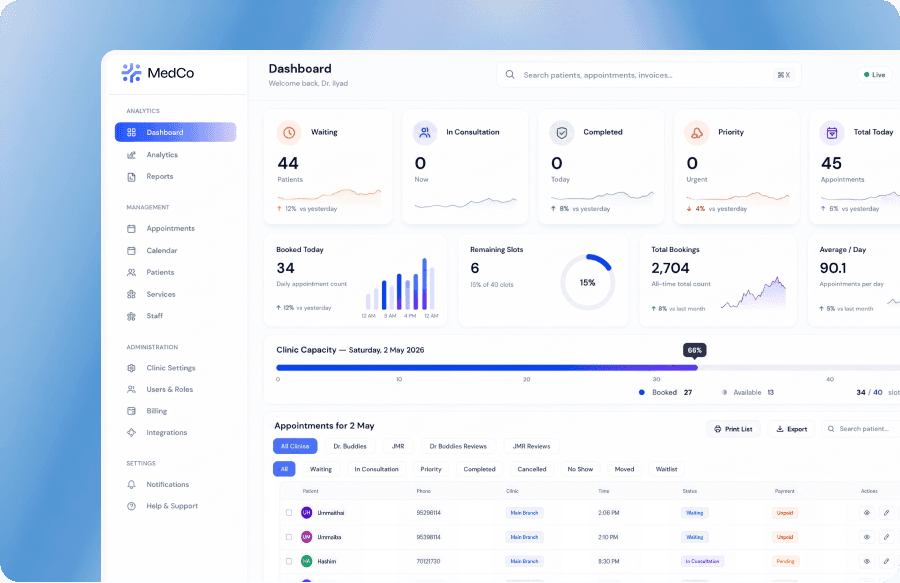
A dashboard designed to help clinic teams monitor operations, identify priorities, and respond quickly throughout the day.

Early calendar concepts focused on helping staff understand availability, appointment density, and provider workloads without overwhelming the interface.

Creating a patient workspace where medical history, upcoming appointments, and key information remain accessible without interrupting the clinician's workflow.
Lessons
Great healthcare products reduce cognitive load, not just clicks.
Designing MedCo reinforced that the biggest challenge in clinical software isn't fitting more information onto a screen. It's helping people find the right information at the moment they need it. Every design decision, from layout hierarchy to navigation patterns, should reduce mental effort so healthcare professionals can focus on patient care instead of the software.